User Guide
See Frequently Asked QuestionsIntroduction
Data Gatekeeper is an all-in-one change logging, auditing, data change approval and control system for Business Central.
Here are just a few of the things it can do.
Data Gatekeeper Setup
Each page or subpage in Business Central has a source table. For the Data Gatekeeper FactBox to appear on a page. We only need to add the table to the Data Gatekeeper Setup.
For read-only pages such as the Posted Sales Invoice (Sales Invoice Header 112), adding the table is all we need to do. When the Sales Header record is posted for a document of type Sales Order or Invoice, data is copied to this table. Since we don't normally alter data for posted records, there's nothing to monitor hence no additional setup is needed. We are simply adding it, so that the FactBox can appear. Our extension tracks this therefore, it will be able to show the related change logs.
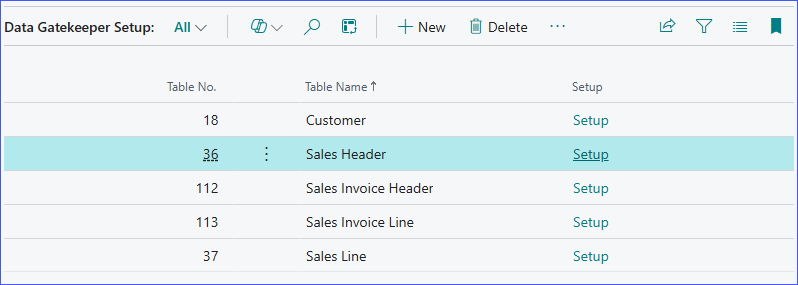
Pages such as the Sales Quote, Sales Order, Sales Invoice, etc. shares the same table (Sales Header 36). Adding the table will result in the Data Gatekeeper FactBox appearing on all of these pages. Since data can be altered in these pages, additional setup is warranted. Click Setup to open advance settings for the table.
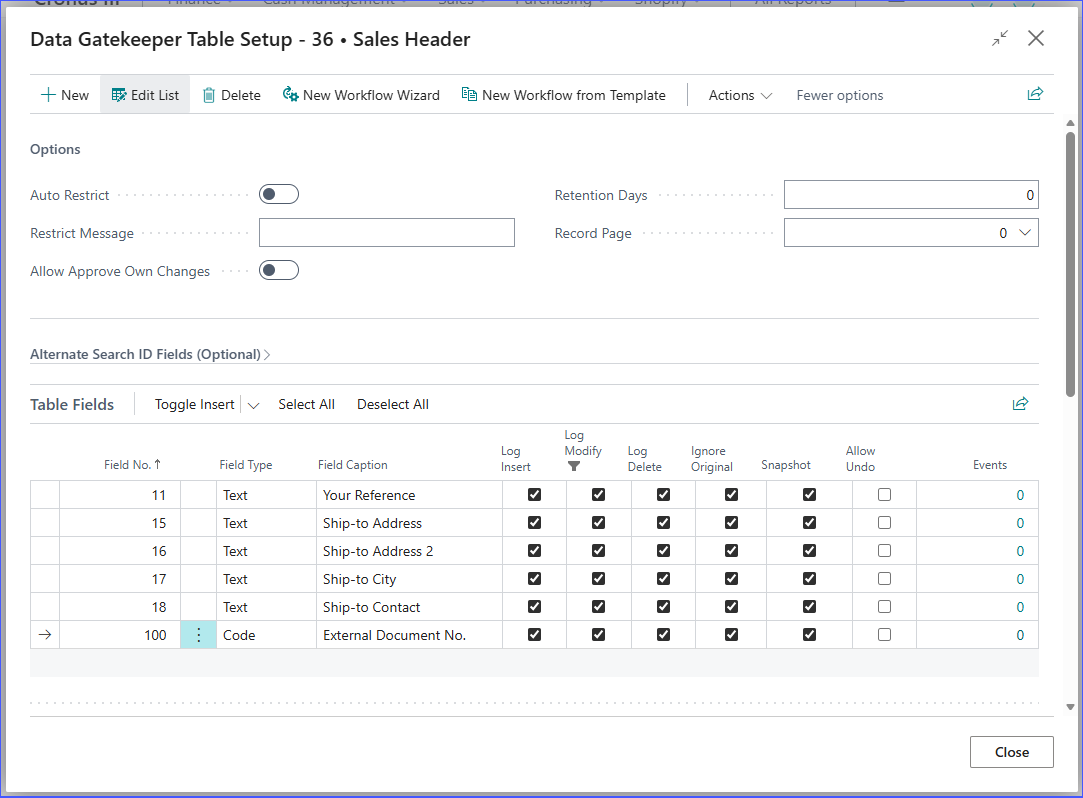
Settings
- Auto Restrict
- If enabled, the system automatically adds a record restriction when a change is detected and removes it when the record is restored to its original state.
- Restrict Message
- This is the message that will appear in the Restricted Records page when a record is auto restricted. The default value is "This record is restricted due to unapproved changes." You can customize this message to provide more context or instructions to users who encounter restricted records.
- Retention Days
- The number of days after the log date that the record will expire. This value effectively controls the record's Log Expiration Date, which can be used by the Retention Policy for table-specific retention periods. Choose the 1 WEEK Retention Period policy and take the 7-day period into consideration when setting up this value.
- View Record Page
- If specified, this page will be used to view the record. This includes the link in the notification email that opens the record requiring approval.
Approval Options
- Enable approval requests for this record.
- If checked, users can request approval for this record from the FactBox.
- Enable parent approval request for this record.
- If checked, users can request parent record approval for this record from the FactBox.
- Include change logs and comments in notification email.
- If checked, the notification email includes the list of changes and approval comments, when available.
- Allow to approve own changes.
- Users in the approvals list can always approve their own changes. This setting is applicable only to a multi-user approval scheme where there are at least two users in the list. If not checked, the approval response will not execute for a user who is both the requester and an approver.
- Auto restrict parent record on child record change or restriction.
- If checked, when a child record is changed or restricted, the parent record is automatically restricted. When the child record is restored to its original state, the restriction is removed. The parent record restriction is also automatically removed unless it has its own restriction.
- Auto-commit and link pending logs to parent record approvals.
- Applicable only when the Parent Table No. is specified. If checked, when a parent record is approved, the system will automatically commit any uncommitted change logs for the child record and link those logs to the parent record approval. If not checked, you must set up an approval workflow for this record or some other event to commit the logs.
- Take a snapshot log of the child record when the parent record is approved.
- If checked, when a parent record is approved, the system also takes a snapshot log of the child record.
- Do not delete approval entries when record is deleted.
- If checked, approval entries and comments for this record will not be deleted when the record is deleted. This preserves the approval history. Otherwise, the change logs remain, but the approval history is lost when the record is deleted.
Alternate Search ID Fields
- Alternate Search Field 1-4
- Optionally choose up to 4 fields to use as the Record Search ID. This is useful for tables where the primary key (Record ID) is not a reliable identifier, such as journals, where primary key field values don't translate into ledger key values.
- It also plays a key role in records that are split into multiple tables when posted. For example, when posting a sales order, the Sales Invoice Header is used for capturing invoice detail while the Sales Shipment Header is used for capturing shipment detail. The extension can only be linked to 1 posting record, and the Sales Invoice Header was chosen. Setting the Alternate Search Field 1 to the "No." field for the Sales Header table and the "Order No." field for the Sales Shipment Header table will allow the extension to rely on the Alternate ID field to link and display the related data instead.
Link to Parent
You can optionally link this table (child table) to a parent table to enable event sharing or related record interaction. To establish the relationship, map the relevant fields between the child and parent tables so the system can locate the associated record.
- Table
- You can only specify the parent table.
- Link Field 1-4
- Specify the key fields between the 2 tables that will link the child record to the parent record.
Table Fields
- Log Insert
- Log the value when a record is inserted.
- Log Modify
- Log the value when a record is modified.
- Log Delete
- Log the value when a record is deleted.
- Ignore Initial
- Ignore the change if it is the first or initial value for the field. Even if the field was changed multiple times, it will be ignored as an initial value until Data Gatekeeper flushes or commits the change. Ignored values can still appear in the Data Gatekeeper FactBox, but it will be discarded before changes are committed.
- Snapshot
- Use this option if you want to reduce stress on the system by not monitoring for every modification but rather, take a snapshot of field values when an event occurs, such as when an approval request is approved or a field value meets certain conditions. NOTE: Snapshots will not be taken of fields that have an initial value, and the Ignore Initial is checked.
- Allow Undo
- Allow users to undo the change/restore the value to what it was before. WARNING: This should only be set for fields that users can edit, not for fields that can only be programmatically set since it can potentially allow users to undo changes that were programmatically set.
- Sensitive Data
- Mark the field as containing sensitive data. This will cause the field to be masked under the Data Gatekeeper FactBox, Data Trail report, and in the notification email. This is useful for fields that contain sensitive information such as Tax ID and Bank Account Numbers.
- Show on Req. to Approve
- If checked, the field will be loaded into the Data Gatekeeper • Record Preview FactBox when the record is viewed in the Request to Approve page. This helps approvers quickly see the relevant data without having to open the record.
- Events
- Allows you to conditionally run events when the field's value changes. The number indicates how many events were setup for the field. Click on the field value to bring up the Field Events setup screen.
Field Events
- Custom
- This is only applicable if you need more power and have custom code that you've developed. By subscribing to our custom event, this will execute your custom code.
- Send an email.
- Error
- Display an error message which will prevent the user from updating the field's value.
- Flush Ignore Initial
- This tells Data Gatekeeper to immediately discard all changes where data in the field was marked as initial value. Any subsequent change will then be marked as a modification.
- Message
- Display a message but doesn't prevent the user from updating the field's value.
- Notification
- Display a message in the form of an unobtrusive notification as opposed to a popup message.
- Add Restriction
- Add a record restriction with a specific message such as, "Amounts over 10K requires approval.". Conditionally set the event to occur only if the Amount field is over 10K, for example. NOTE: This applies only if another restriction doesn't already exist for the record.
- Remove Restriction
- Remove a record restriction if it has the specific message such as, "Amounts over 10K requires approval.". Conditionally set the event to occur only if the Amount field is less than 10K, for example.
- Set Field Value
- Set the value of a field to a specific value when the event occurs. For example, if the Unit Price field is over 1000, set Blocked to True.
- Set Field Value (Confirm)
- Prompt user to confirm before performing the Set Field Value action. If user cancels, pending changes will be rolled back.
- Take a Snapshot
- This tells the system to take an immediate snapshot of all fields that have snapshot enabled, and immediately commits the log. This may include other monitored fields that are in a pending log state, regardless of the field's snapshot setting. These entries will appear in the Data Trail as "Snapshot" under the Sender followed by the user who triggered the snapshot under the Approver. NOTE: If auto restriction is turned on for this record, this will effectively unrestrict the record.
Subscription Events
Defining restrictions on a record does not automatically prevent actions. Restrictions must be validated during the relevant operations to be enforced. For tables that do not include built-in restriction checks, subscribe to the provided events to validate related records as required.
Take a Snapshot events will cause the system to take a snapshot of fields on the child table that has snapshot enabled.
The parent table for subscription events are dictated by the event's setup. The system will automatically set the parent table for the subscription when it can determine the correct table. Otherwise, you must select the appropriate table. Selecting an incorrect table may result in an error or event that is not applicable. If the parent table is the same as the child table, then field mappings are not necessary.
For example, report events can have different source tables, depending on the report. Therefore, the system cannot automatically set this. You must select the correct parent table for the report you're expecting. The event will apply only when the report's source table matches the parent table you selected.
You must map the relevant fields between the parent and child tables, so the system can identify the corresponding record to apply the event to.
Copy Setup
When there are multiple companies, it can be hard to maintain the settings across all. If all companies share the same setting, then use the "Copy Setup to Other Companies" under the Actions menu to easily copy the settings over. For flexibility, only settings from the selected tables are copied, and only to the companies that are chosen for the copy operation.
Data Gatekeeper FactBox
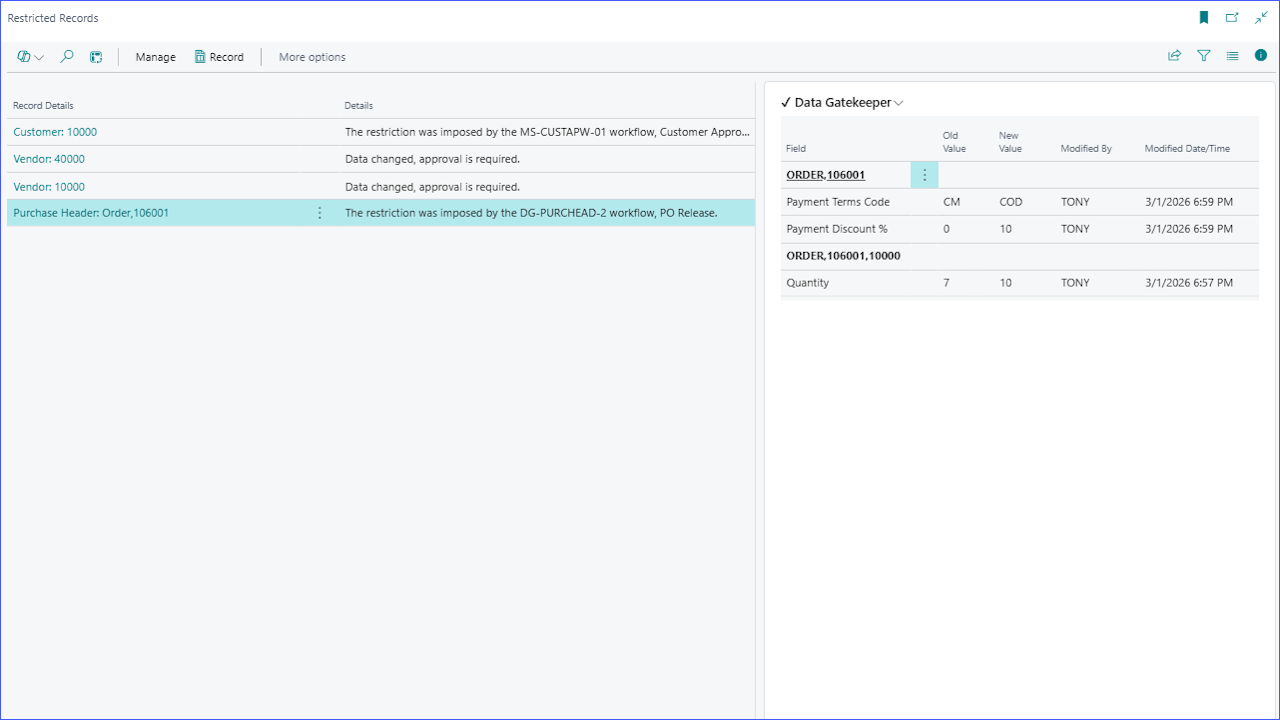
Displays pending and committed changes for the current record. The information shown depends on the record context.
For example, on a Purchase Order, two FactBoxes may be displayed—one for the header and one for the lines. This separation ensures a clear distinction between header and line data to prevent confusion.
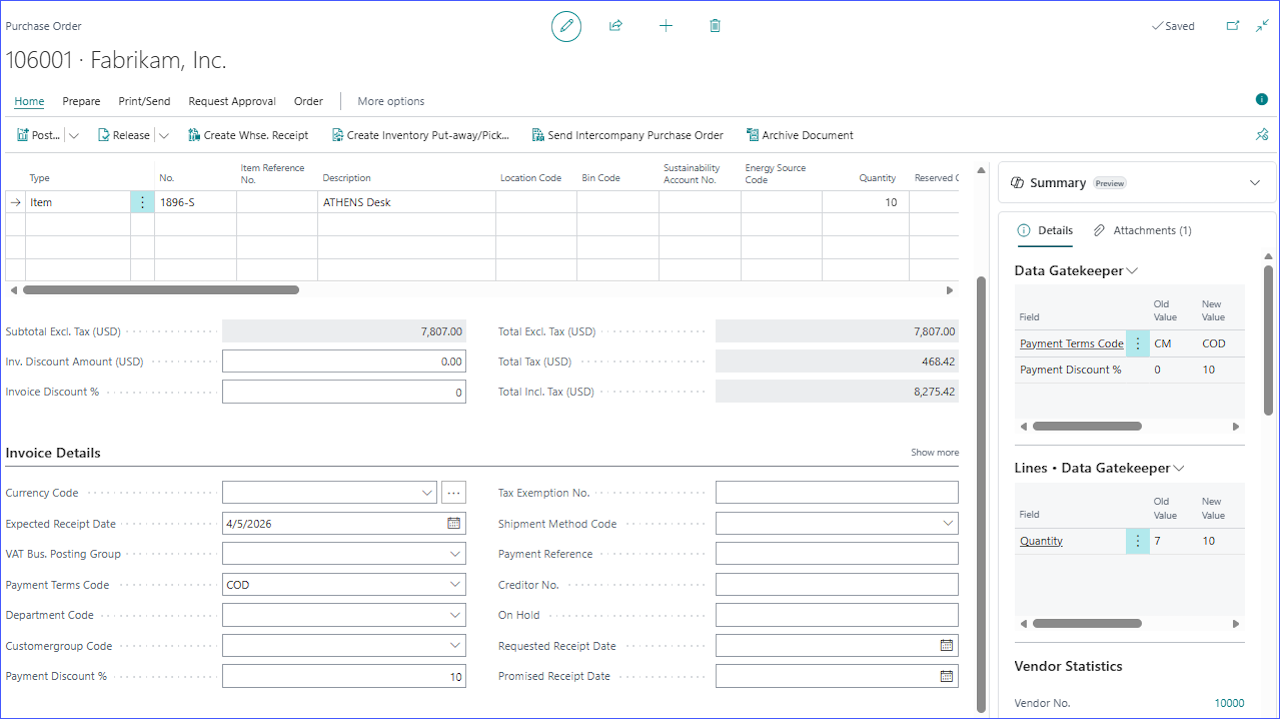
The Restricted Records page displays one FactBox that combines header and line changes for simplified review.
Menu Options
- Undo Change
- Restore the selected entry's value back to its original value if allowed.
- Data Trail
- Opens the Data Trail to see committed change logs for the record.
- Zoom
- Opens a larger view of the log.
- Open in Excel
- Export the contents of the factbox to Excel.
- Approvals
- This includes the standard approval-related actions that are available on most pages, centralized for convenience and extended to pages that do not include built-in approval functionality.
Data Trail
To view committed change logs for the current record, open the Data Trail page from the Data Gatekeeper FactBox menu.
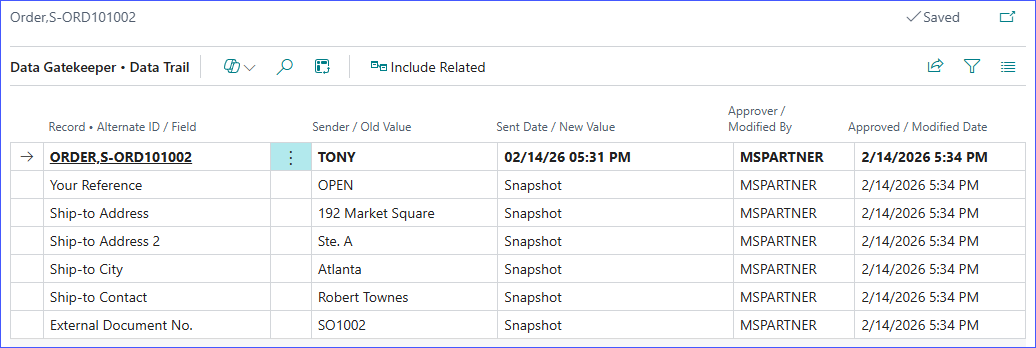
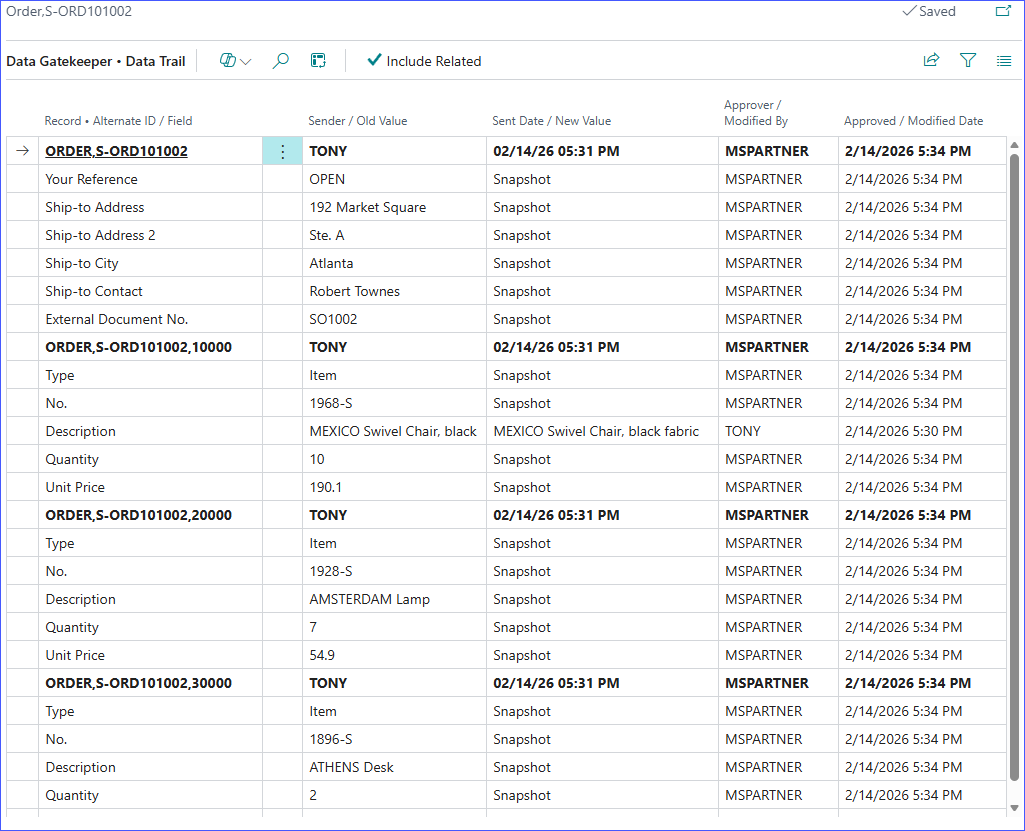
For records with a parent-child relationship, check "Include Related" to display the associated child records.
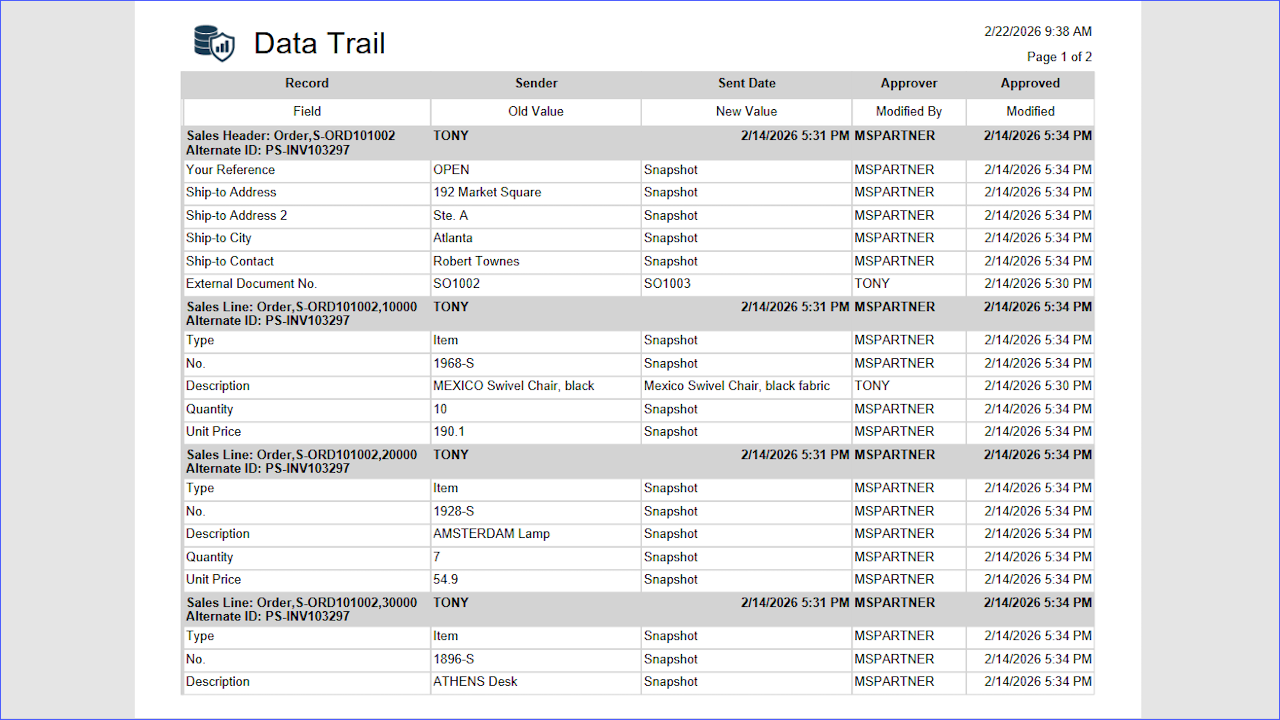
To view change logs for multiple records, use the Data Trail Report.
Data Gatekeeper Workflow Wizard
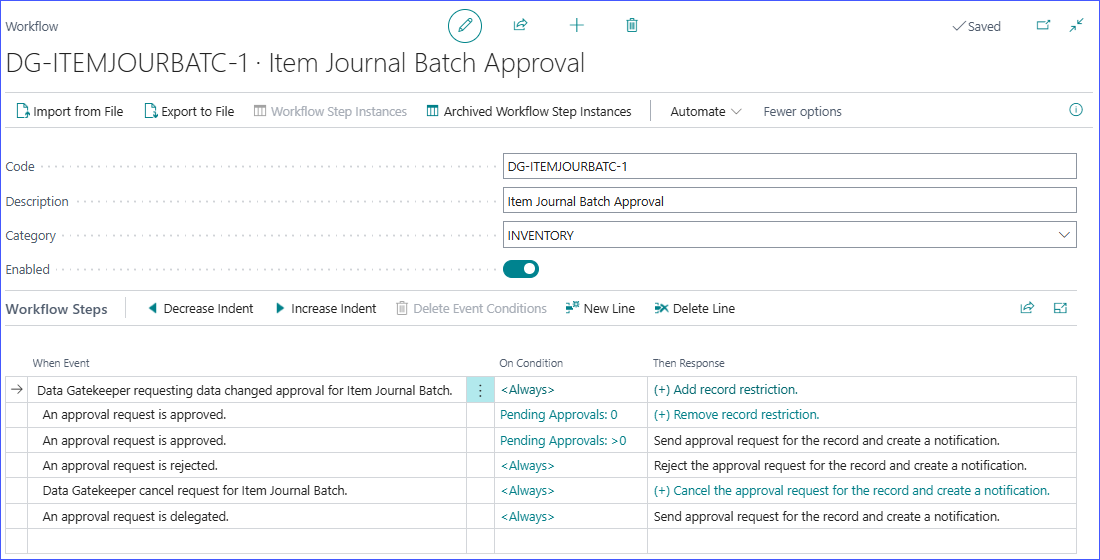
Use the workflow wizard to create approval workflows in just a few easy steps.
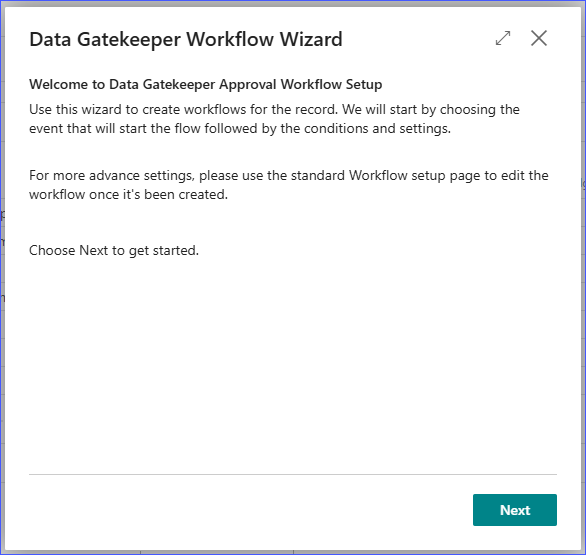
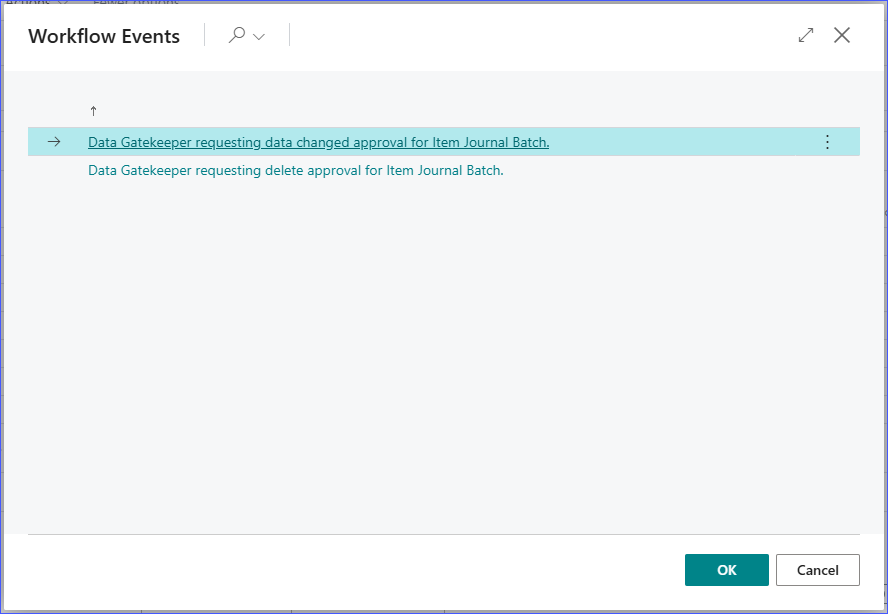
The wizard will only show events applicable to the selected table.
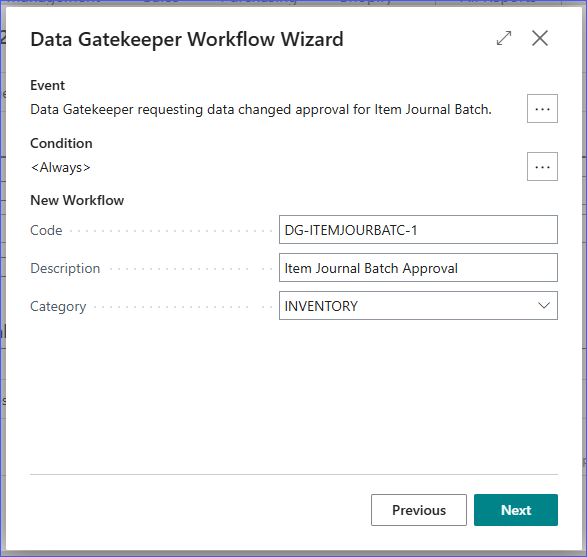
Choose the event, set the conditions, give it a description, and choose a category.
Additional settings.
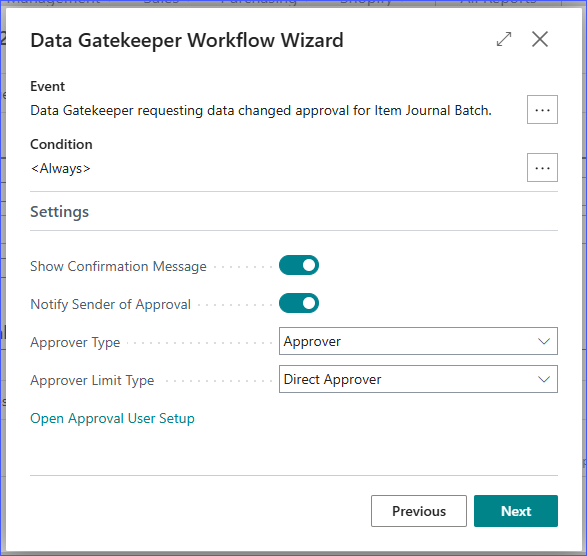
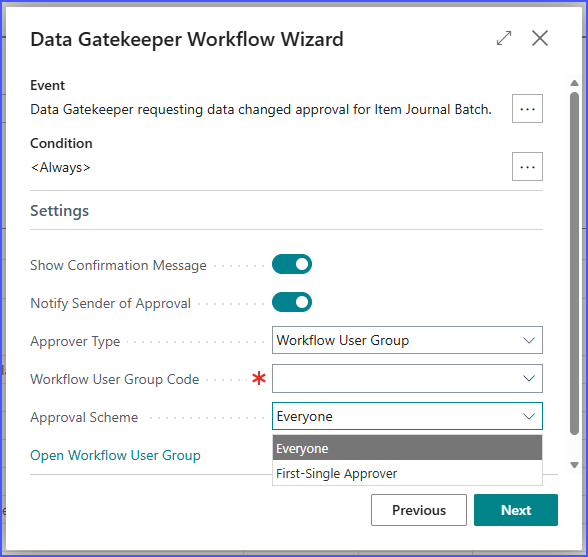
- Show Confirmation Message
- If enabled, the system displays a confirmation message to inform the user that a request has been sent.
- Notify Sender of Approval
- When enabled, the user is notified when the request is approved.
- Approver Type
- The approver scheme to use for this workflow.
- Approver Limit Type
- Applicable when the Approver Type is Salesperson/Purchaser or Approver. Choose how approvals are routed.
- Workflow User Group Code
- Applicable when the Approver Type is Workflow User Group. Select the group that will handle this approval.
- Approval Scheme
- Applicable when the Approver Type is Workflow User Group. Select from the 2 schemes below.
- Everyone - Everyone in the group must approve.
- First-Single Approver - The 1st person in the group to approve will approve for all.
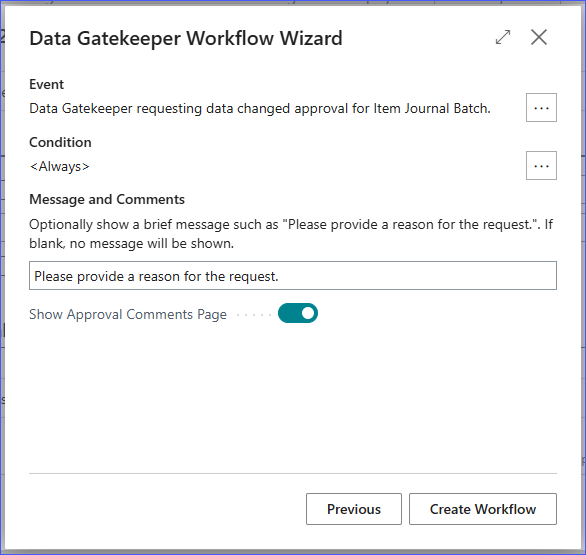
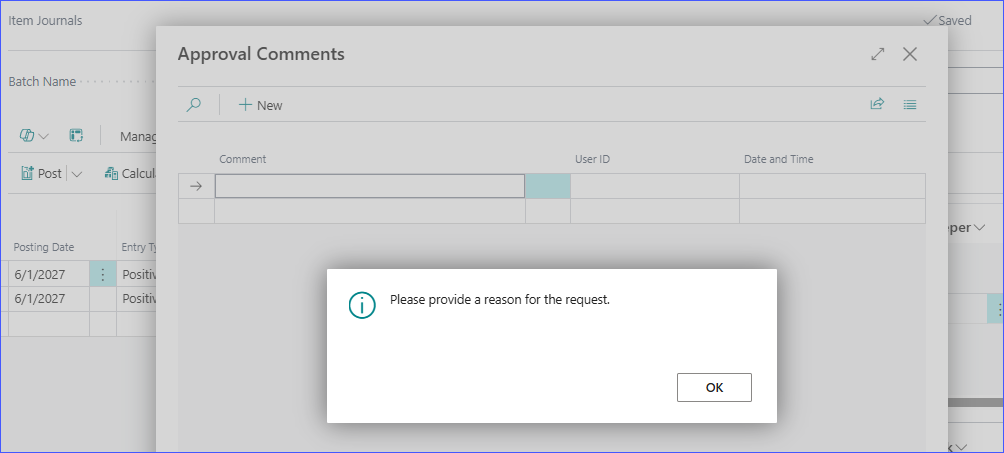
To allow comments on a request, enable Show Approval Comments Page. When enabled, the comments page appears before the request is sent, allowing the requester to add comments. If the option to include comments in notification emails is also enabled, the comments are included in the email sent to approvers.
Once the workflow is created, the standard Workflow card will appear to allow more advance settings.